Raise and sign a change order
A change order is how a contracted project changes its price, its scope or its cost without losing the record of what was agreed. There is no separate change-order editor: you revise the proposal the client signed, and Florio treats that revision as a change order from the moment you open it. This page follows one through from the contract card to the ledger.
Before you start
The event needs a live contract, which it gets automatically when the client accepts a proposal (see the contract card). You need permission to manage contracts to start one, the usual proposal permissions to edit and approve, and the permission to manage contracts again to apply an internal change order. Approving a re-estimate is a separate permission, normally held by finance.
Start the change order
- Open the event’s Financials tab and find the Contract card.
- Choose New change order. Florio copies the signed version into a new draft and opens it in the proposal builder.
- The builder is now in change-order mode. A banner at the top says so and names the contract value, and a strip shows Contract value today, This version and Change order value side by side. That strip updates as you edit.
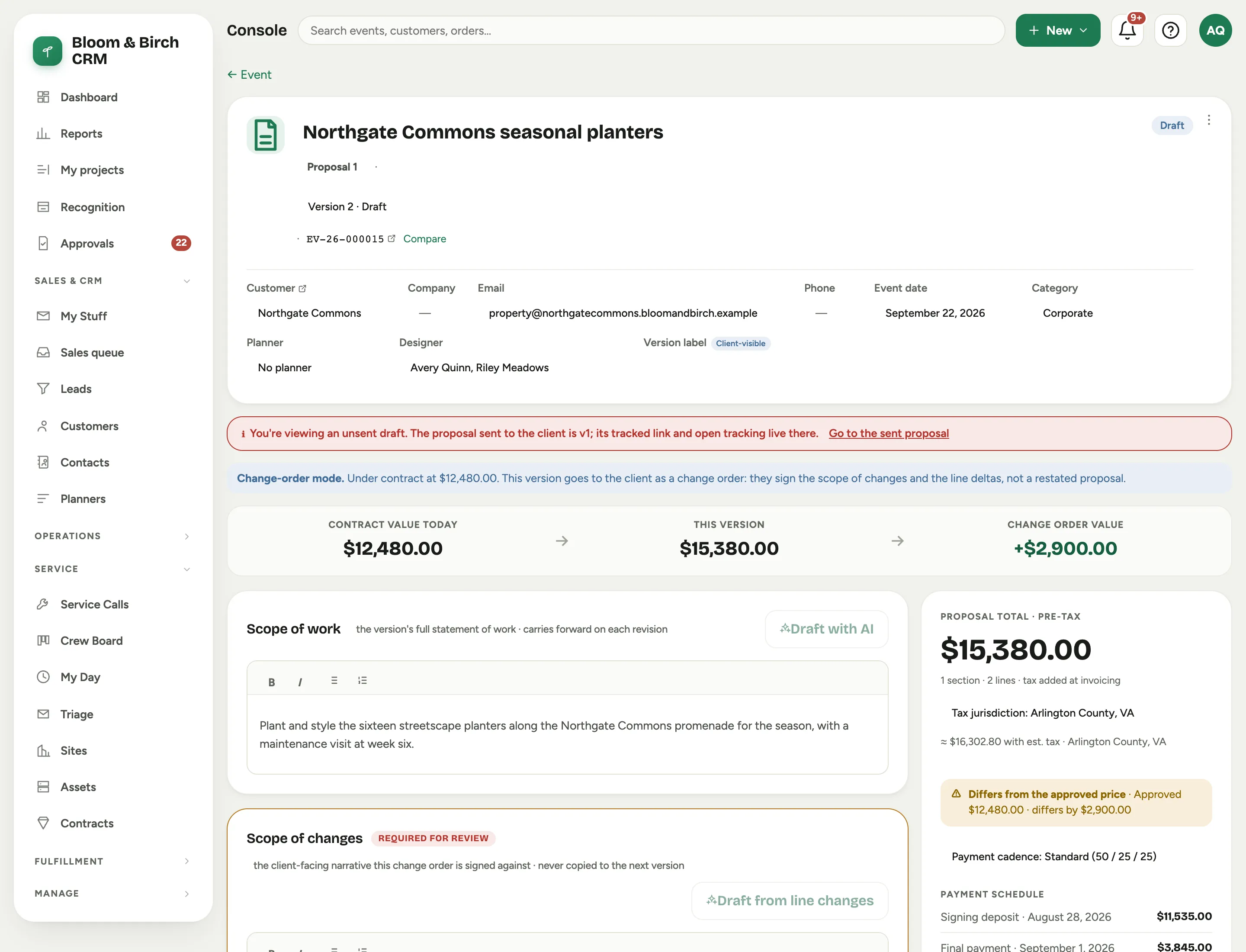 Screenshot from a demo workspace; data illustrative.
Author the changes
Edit lines exactly as you would on any proposal: change a quantity or a price, add a line, delete one. Every line carries a tag against what the client signed:
- Added on a new line.
- Changed on a line whose price, quantity, cost or hours moved, with the old value shown as “was” under it.
- Removed on a baseline line you deleted. It stays on the page, struck through, with a Restore button. Removing a line is a change the client signs, not an erasure.
Costs and hours count too. A change order that adds a line with a cost of $480 and two hours of setup carries those into the projected final cost when it is approved.
Write the scope of changes
The Scope of changes card sits under the scope of work and is marked Required for review. Describe what is changing and why, in the client’s terms. This narrative is what the client signs, and it leads the review screen, so Submit for approval stays blocked until it is written. See Write the scope of work for the difference between the scope of work and the scope of changes.
Review and approve
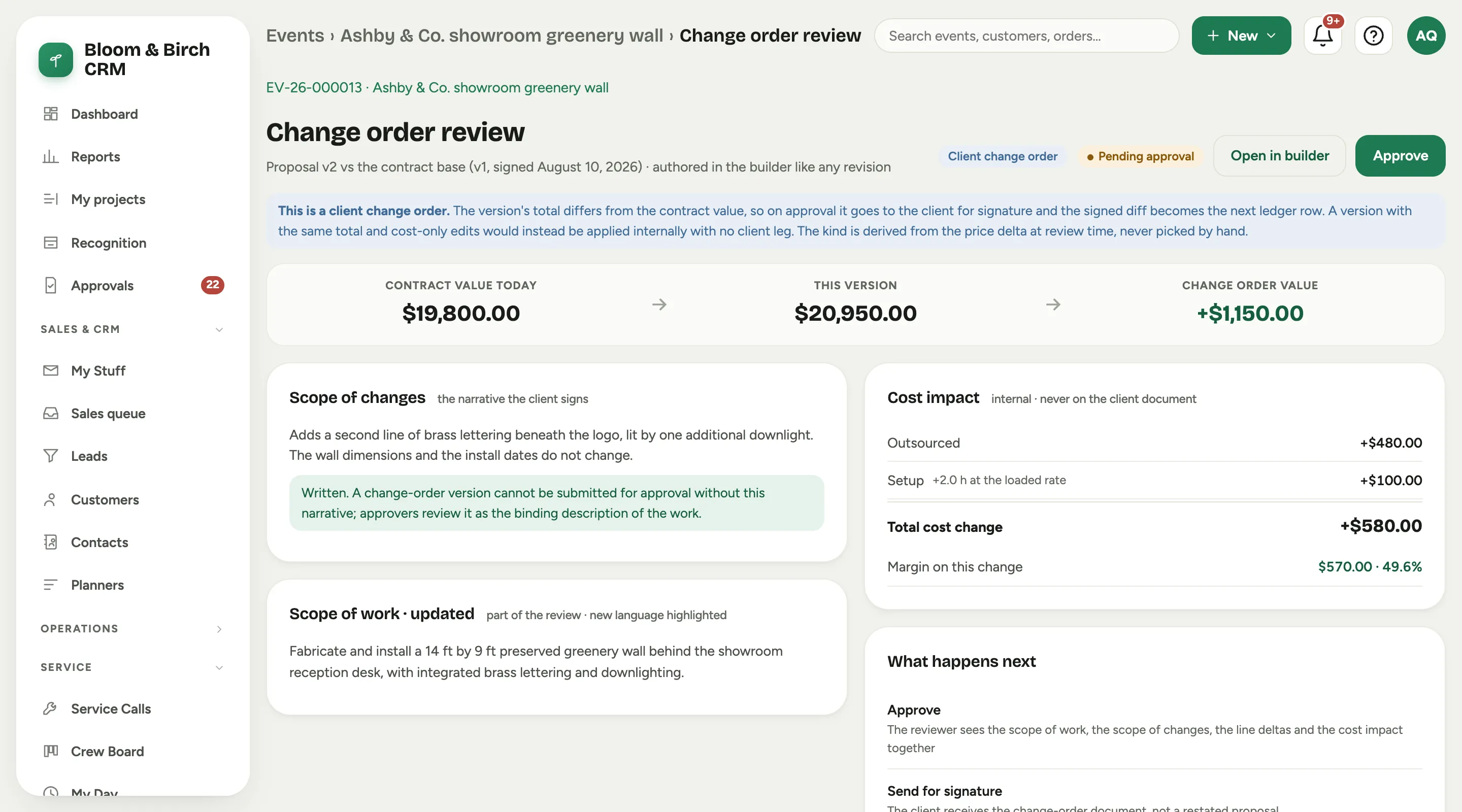
Submitting takes you to the Change order review. The header states the kind, derived from the price and never picked by hand:
- Client change order when the total differs from the contract value.
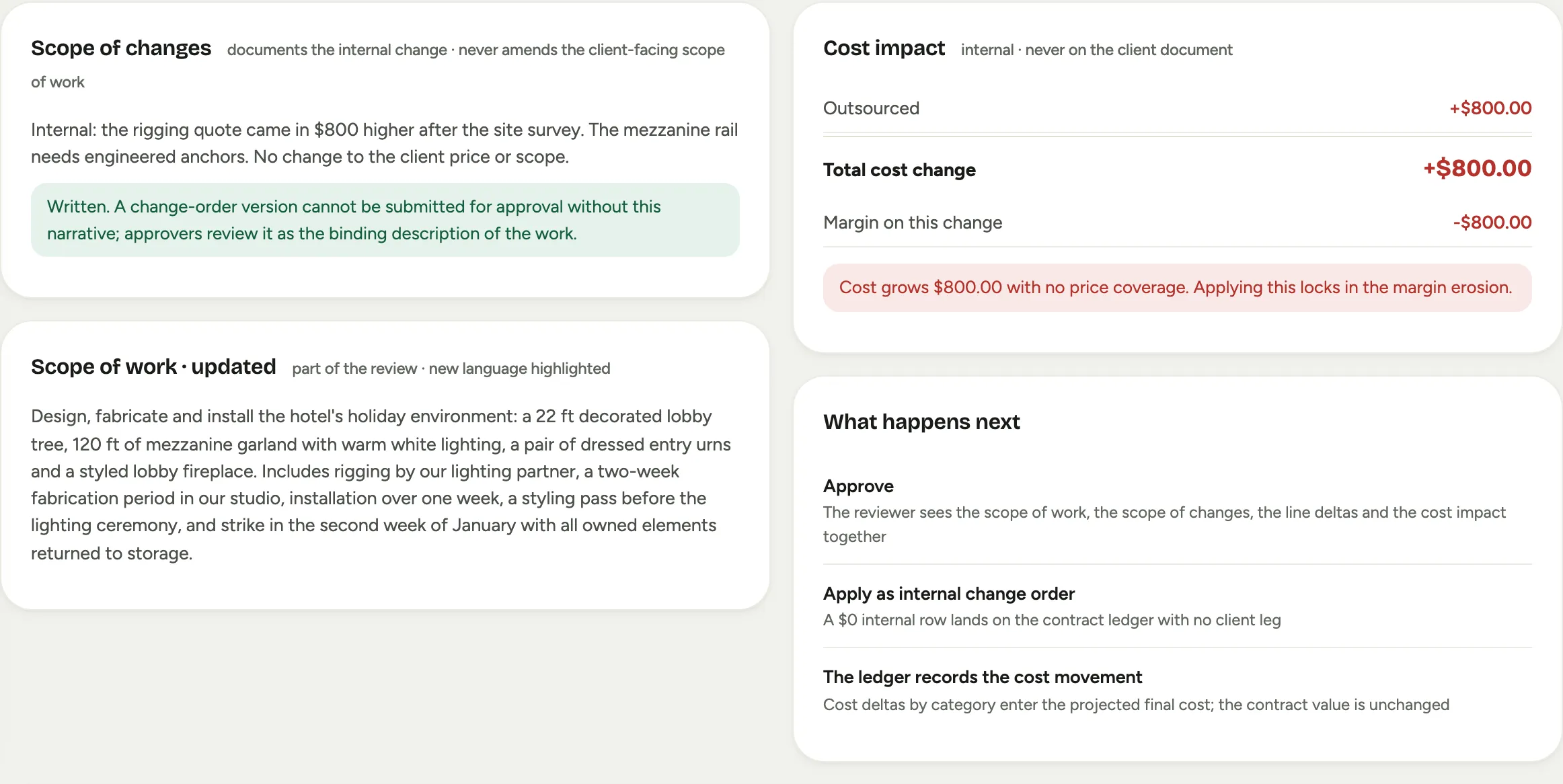
- Internal change order when the total is the same and only costs or hours moved.
 Screenshot from a demo workspace; data illustrative.
The review shows the scope of changes, the updated scope of work with the new language highlighted, the Line changes table by lineage (price, cost and hours together), and, for people who can see costs, the Cost impact panel with the Total cost change and the Margin on this change. On a client change order the cost and hour deltas are shown in neutral ink, because they are priced work; the margin on the change carries the judgment, and it warns when this change alone falls below your target margin. On an internal change order the cost growth reads in red, and the review flags that applying it locks in the margin erosion.
 Screenshot from a demo workspace; data illustrative.
The approver chooses Approve. The What happens next rail on the right says what follows for this kind.
Send it for signature, or apply it
For a client change order, choose Send for signature after approval. The client receives the change-order document, not a restated proposal: the scope of changes, only the lines that changed (a removed line shows its title struck through with a negative amount), the contract value before and after, the estimated sales tax on the change, and an accept box.
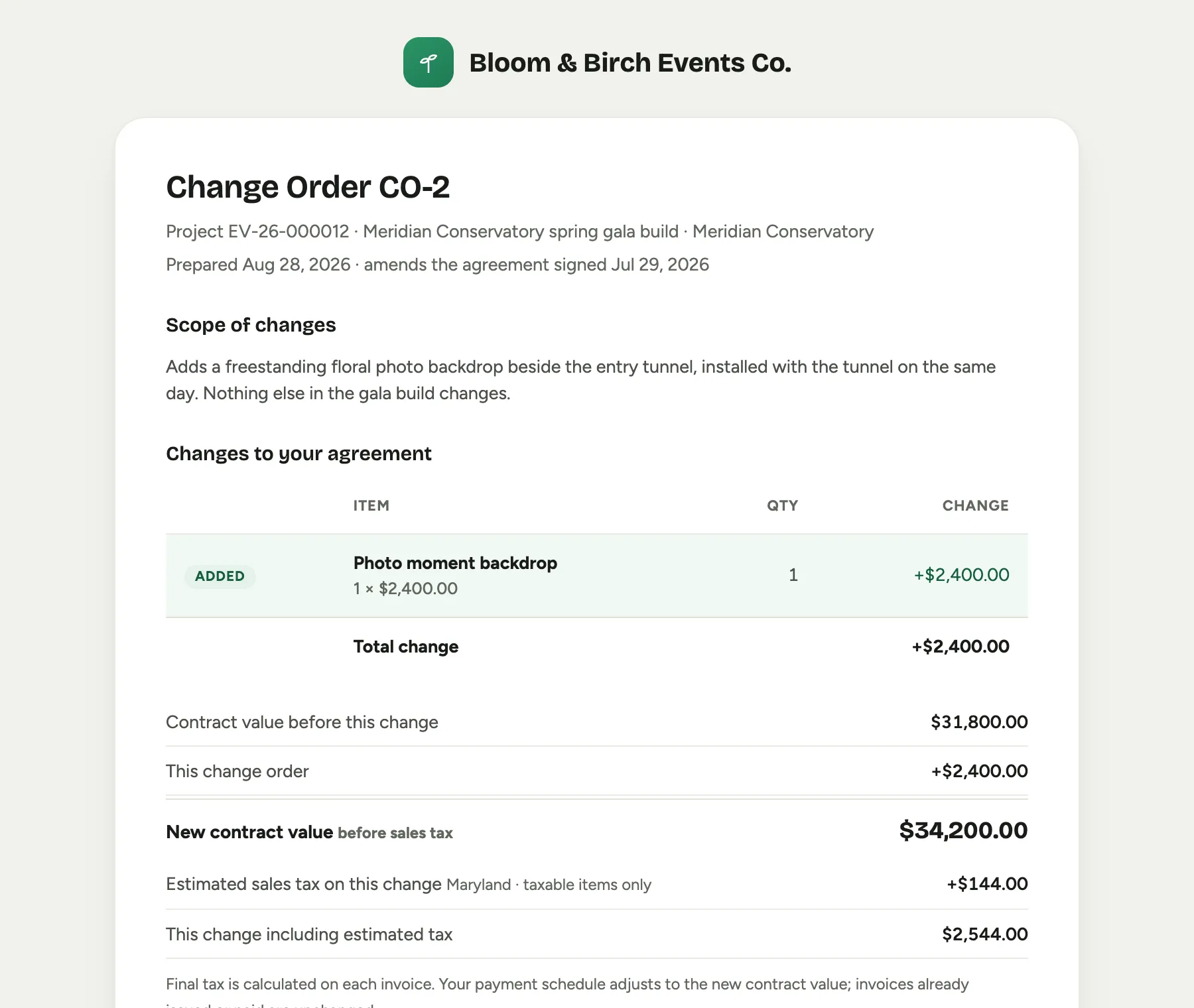 Screenshot from a demo workspace; data illustrative.
When the client accepts, the signed difference becomes the next row on the Revision ledger, the contract value moves, and the payment schedule re-amortizes; milestones already billed or paid are untouched. The row’s view CO document link opens the signed document again later.
For an internal change order, choose Apply as internal change order after approval. A zero-value row lands on the ledger, the projected final cost moves by the cost change, and nothing goes to the client.
Re-estimates
When cost moves and no proposal line is involved, for example a subcontractor quote that came back higher, use New re-estimate on the contract card instead. Enter the movement by Cost category with an Amount each, write the Reason (required), and choose Create draft. The draft lands on the ledger as Draft; Submit for approval moves it to Pending approval, and someone with the approval permission chooses Approve. Void discards a draft or a pending row. Approved rows are never edited, so a mistake is corrected with another revision.
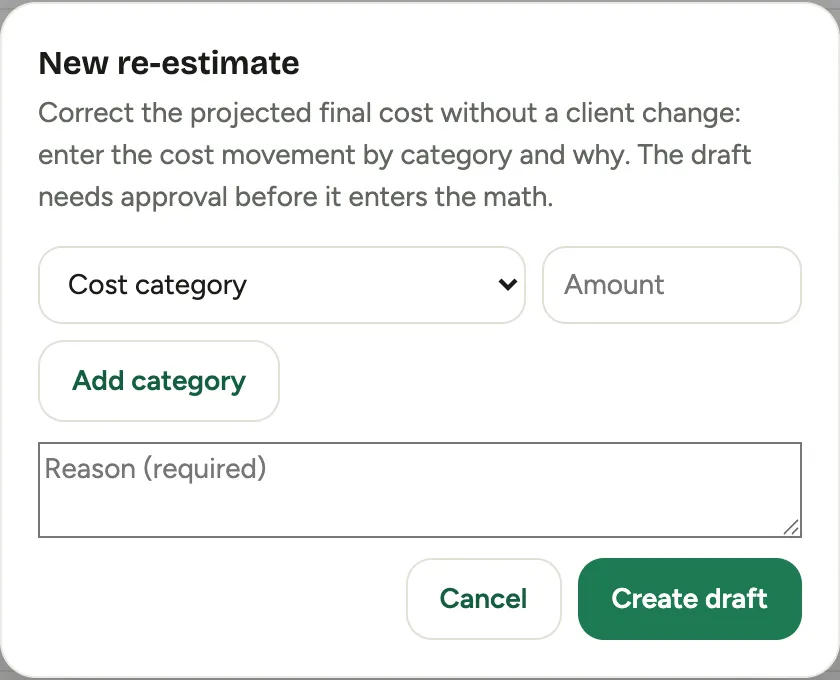 Screenshot from a demo workspace; data illustrative.
A re-estimate raised from unapproved materials cost asks only for the reason and fills in the amounts by category for you; see Approve planned cost.
Good to know
- One change-order draft at a time. New change order refuses while a draft or a version awaiting approval is already open on the proposal; finish or discard that one first.
- A change order on a project that is already closed is refused and recorded, so a late change never disappears silently.
- The ledger keeps the order things happened. A voided revision is dropped from the card but kept in the event’s activity history.