Set up Florio Service
Florio Service is an add-on. Once it is enabled for your workspace, everything about how it runs, your labels, your response targets, who gets dispatched, lives on one Admin screen.
Before you start
Florio Service is available on request. See the add-on entry on the pricing page, or ask us through the request form. You need the settings permission to change any of this. Find it under Admin, then Service.
Turn on the module and set your labels
- On the Service tab, turn on the Field Service Module. That reveals Service Calls, Sites, Assets, Contracts, and the dispatch board for everyone with service access.
- Under Call Statuses, name the stages your team uses. Each of your labels maps to a fixed platform category (new, in progress, on hold, resolved, closed, cancelled), which is what the engine reads, so you can word them your way without breaking anything. Dispatch Statuses work the same for visits.
- Under Call Categories, add the kinds of work you do (irrigation, lighting, audiovisual), each with a default visit length that pre-fills a new visit.
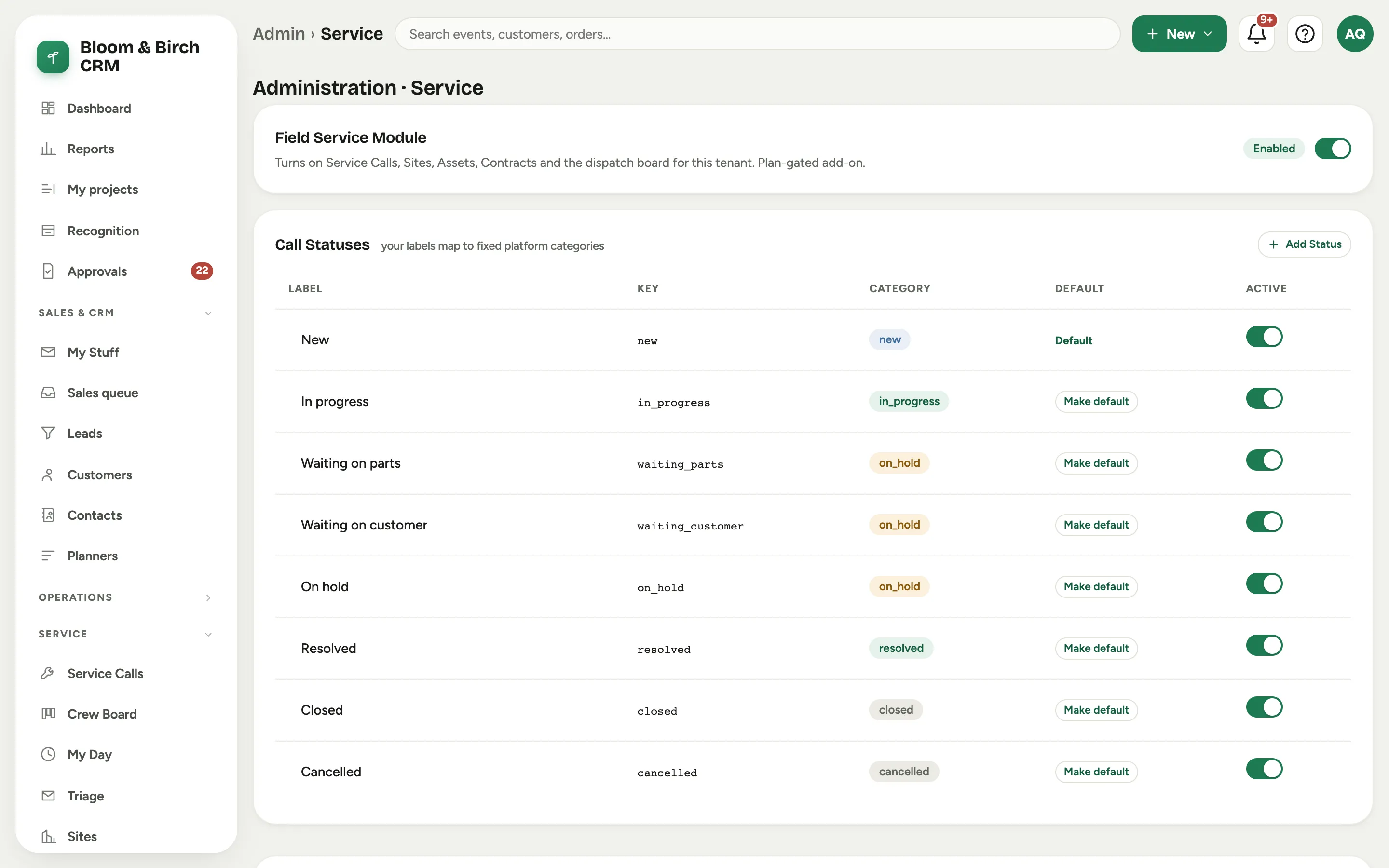 Screenshot from a demo workspace; data illustrative.
Set your targets, rates, and pool
- Fill in the SLA Priority Matrix: for each priority, the first-response and resolution targets in business hours or business days. These drive the Due dates and the at-risk flags on every call.
- Under Rates & Targets, set the labor bill rate, the default burden, your utilization and SLA-attainment goals, and the service desk phone.
- Under Dispatch Pool, choose who can be sent to a site: everyone active, specific people, the members of a role, or the members of a queue. Turn on Release Notifications so a technician is alerted when a visit is released to their day.
- Under Queue Owners, set who owns each service queue so unmatched intake and new calls route to a person.
Choosing who appears on the board
The pool decides two things at once: whose row shows on the Crew Board, and who the technician picker offers. Four ways to say it:
| Pool source | Use it when |
|---|---|
| Everyone | small teams where anyone might go out |
| Specific people | you want to name them, and change the list without changing anyone’s access |
| A role | your roles already line up with who goes to site |
| A queue | you already run a queue whose membership is the same set |
Specific people is the plainest of the four and usually the right one. Because it names people directly, adding someone to the board later is a checkbox: nothing about what they can see or do in Florio changes. Picking a role instead ties board visibility to permissions, so adding a project manager to a technician role to get them a board row would also hand them that role’s permissions.
Office staff who book the work do not belong in the pool. A dispatcher schedules the board; they are not someone the board schedules.
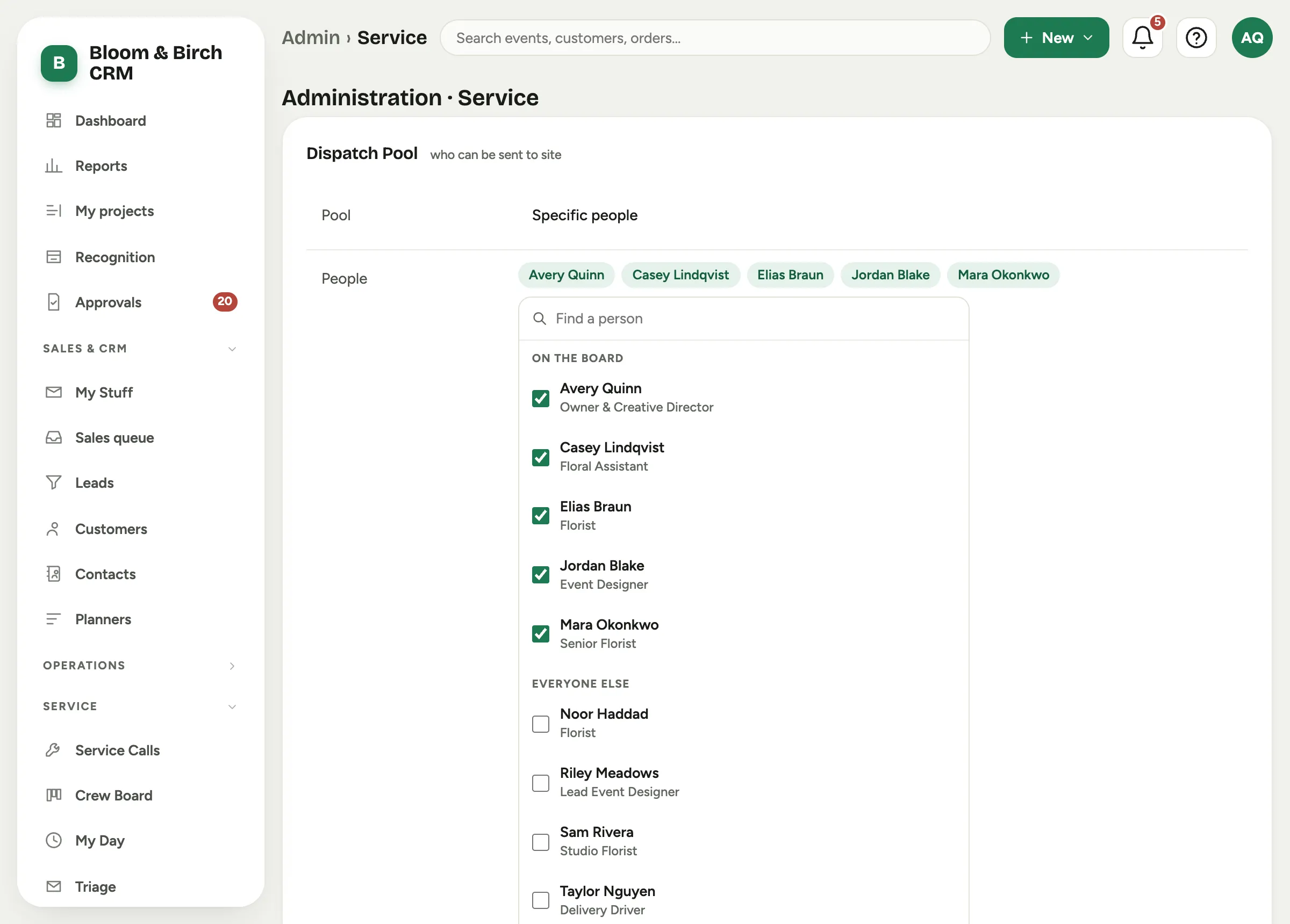 Screenshot from a demo workspace; data illustrative.
The request form
The Intake Mailboxes you list here become web-to-case inboxes: mail sent to them opens a service call automatically, and an unmatched sender lands in Triage.
Florio also gives you a public Request Service page to put on your own website. It carries your brand and your reply-time promise, opens a call automatically, matches an existing customer, and needs no account. Ask us for your form’s link when you turn the module on.
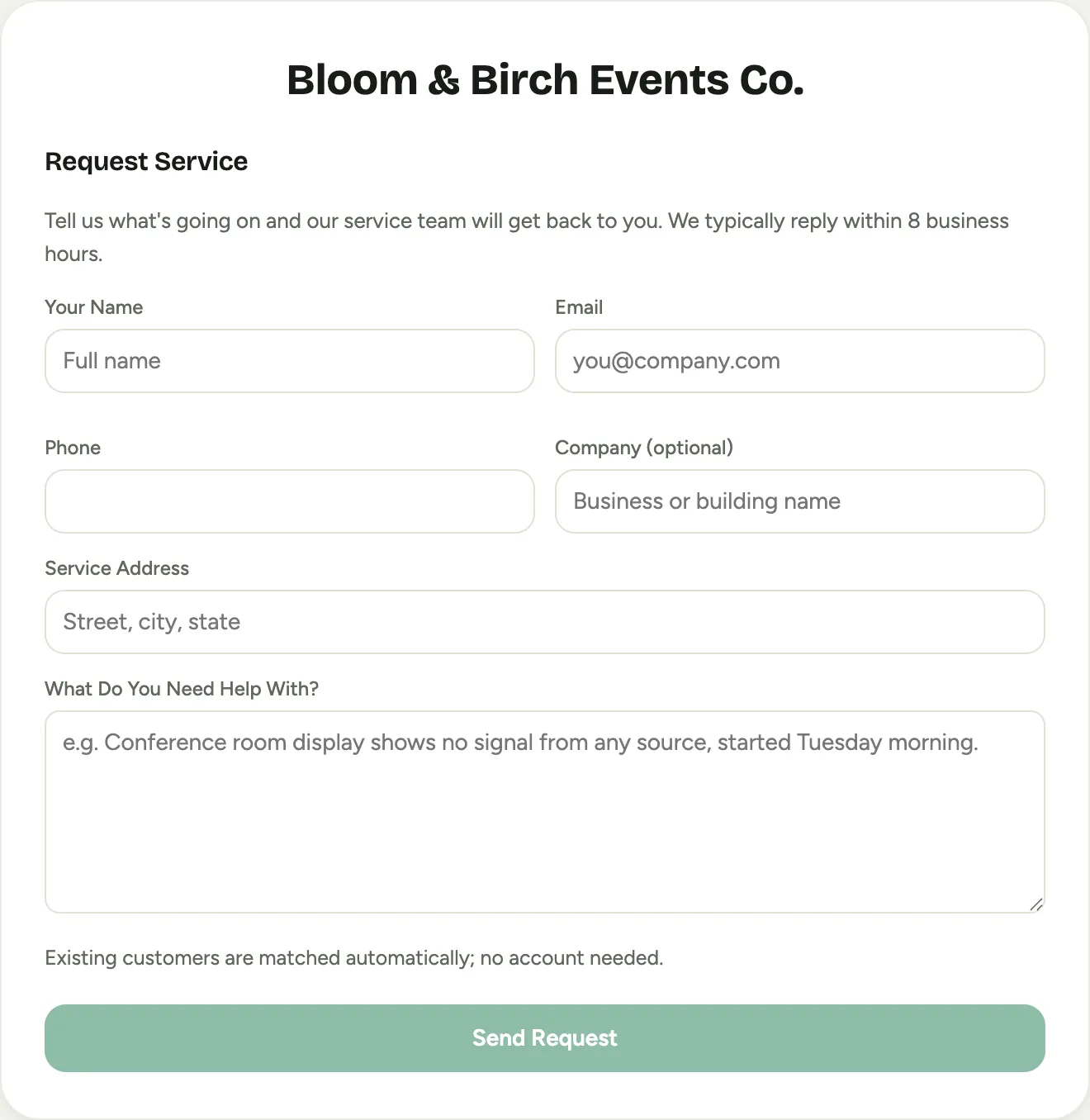 Screenshot from a demo workspace; data illustrative.
Good to know
- Statuses and categories are retire-not-delete: you can deactivate one you no longer use without breaking the history on old calls.
- The dispatch pool is a safety rail, not a lock. If the pool is empty, everyone active is eligible; sending someone from outside the pool warns rather than blocks. That is deliberate: a dispatcher covering a 7am no-show has to be able to send whoever is standing there.
- Someone left out of the pool still appears on the board on any day they are already crewed on a visit. Hiding them would hide the visit, and any double-booking on it.